
Written by Richard Armstrong — AI Software Engineer, Consultant, and Architect
I am often asked a question that seems simple on the surface but reveals enormous depth the moment you begin to unpack it:
“What is the key to solving pain points with AI?”
To answer that, I like to go back to something Steve Jobs said long before “AI” was a buzzword. He reminded us that real innovation begins not with the technology, but with the human experience behind it. You start with people, their friction, their frustrations, their needs, and only then work backward toward the technology that solves those problems. If you start with technology first, you end up wandering in circles trying to justify tools that never should have existed in the first place.
Today, AI is everywhere. Executives want to deploy it like a magic wand. Entrepreneurs want to build “the next big thing.” And entire industries are mesmerized by the shiny-object energy AI brings into every boardroom. But underneath all the hype and potential is a truth many leaders quietly admit once they’re behind closed doors: AI is powerful, but it is also complex… technically, operationally, ethically, politically, and culturally.
The organizations that win with AI are the ones disciplined enough to understand both the power and the limits of the technology. They know AI is not a robot employee. It is not a replacement for thinking. It is not a shortcut around process. It is software. Incredibly sophisticated software, that still requires careful problem definition, data discipline, human judgment, iteration, governance, and constant refinement.
And perhaps most importantly: AI should make the world better for the people touching it, not worse.
With that in mind, here are the key principles that truly unlock AI’s potential, not as an outline, but as a story of what actually works inside real organizations.
Begin With a Crystal-Clear Problem
Every successful AI project begins the same way: by slowing down.
The fastest way to fail with AI is to rush into it.
Leaders often come to me wanting automation before understanding what actually needs to be automated. They’ll say “We want AI answering all customer calls” or “We want AI screening every résumé,” but when you dig deeper, you find the real pain point is something else entirely. A broken process, outdated workflow, missing data, poorly defined roles, or a bottleneck created by constant turnover.
So the first step is always a deep examination:
What exactly hurts? Why does it hurt? Who does it impact? And what would a meaningful improvement look like?
That clarity matters because many jobs that AI is asked to “solve” are actually jobs people shouldn’t have been doing in the first place. These are the high-turnover, low-satisfaction, repetitive, mentally draining roles that companies constantly struggle to keep staffed. Sometimes these jobs get stacked together, like the front-desk greeter who is also expected to route phone calls, process paperwork, and triage service requests. The person in that role isn’t thriving; they’re surviving.
When AI is used to alleviate these kinds of burdens, the entire organization benefits. People feel relief. Processes become stable. And most importantly, the employee previously buried in repetitive tasks can step into a new role of higher value… oversight, validation, exception handling, quality assurance, and continuous tuning of the AI system itself.
This is the first moment where AI becomes transformational rather than merely technical.
Let Data Tell the Truth
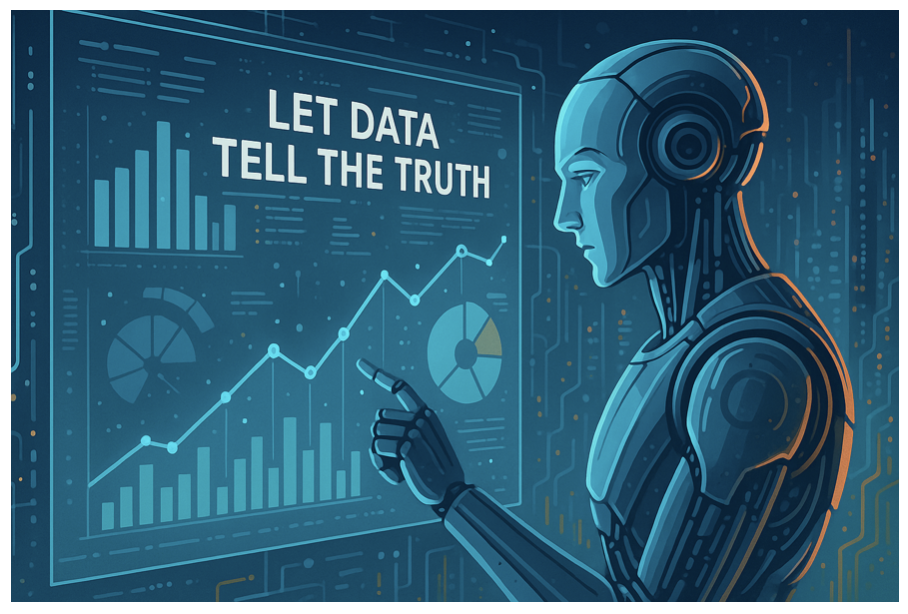
Once you know the problem, you must understand the data behind it.
AI feeds on data the way humans feed on oxygen… no data, no intelligence.
But here’s the catch: most organizations have data that is messy, inconsistent, siloed, or partially missing. Leaders often assume they have “plenty of data,” only to discover that 40–60% of what they need doesn’t exist, isn’t labeled, or contradicts itself across systems.
High-quality AI requires high-quality inputs:
-
- Clean data
- Representative data
- Governed data
- Ethically sourced data
- Accessible data
- Secure, permissioned, compliant data
This is where the human element returns once again. The people closest to the work, the ones who know the daily frustrations, are often the ones who can identify what data is missing or mislabeled. Their insights shape the training sets, the workflows, and the guardrails that prevent AI from hallucinating or making harmful assumptions.
The path to strong AI is paved not with algorithms, but with good data and human insight.
Human–Machine Collaboration Is the Real Superpower
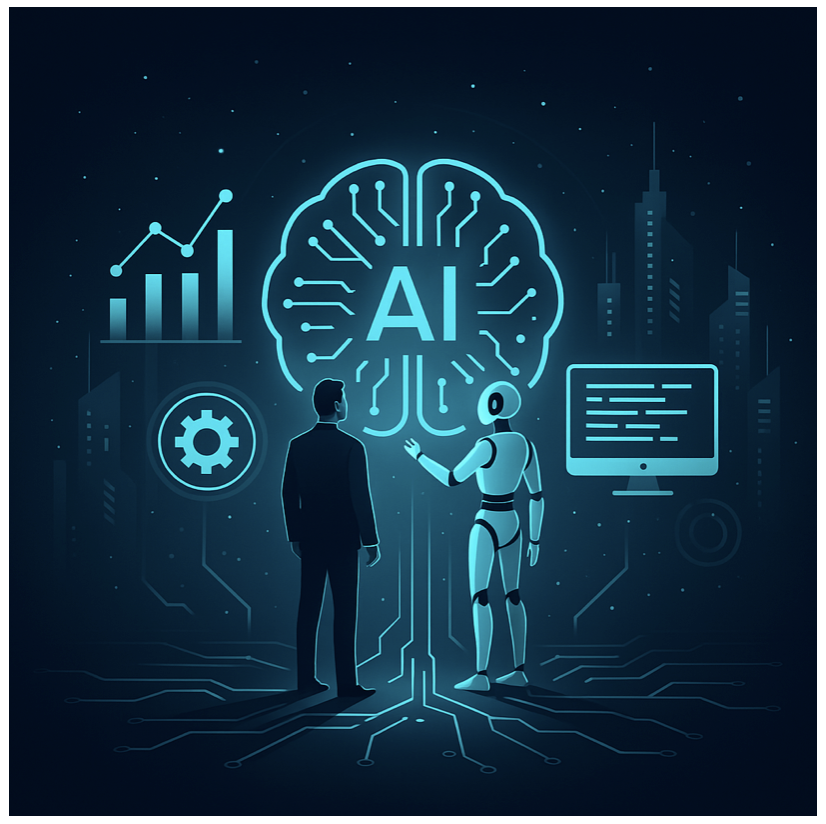
The most successful AI systems are not replacements for people, they are multipliers for people. When implemented correctly, AI becomes the tireless force that handles the tedious, repetitive, soul-crushing work that humans were never meant to shoulder indefinitely.
AI does the heavy lifting:
the repetitive work, the sorting, the triage, the monitoring, the pattern recognition, the scanning of thousands of items a human would never have time to review.
Humans do the judgment work:
the exceptions, the ethical boundaries, the ambiguity, the disagreement, the edge cases, the mentoring and correction of the AI itself.
When AI and humans collaborate and the two forces operate together, the results are unmistakable, and magical things happen:
-
- Customers get answers faster
- Workflows run smoother
- Team burnout declines
- Errors fall off a cliff
- Quality increases
- And people… real people, the ones who used to drown in tasks nobody enjoyed, suddenly find themselves elevated into higher-value, more interesting roles.
And the front-desk employee who once answered phones all day, or sorted applications, or transcribed data, or monitored logs, now becomes the subject-matter expert who ensures the AI is performing correctly. They validate outputs, tune prompts, refine rules, spot anomalies, and escalate decisions that require nuance.
This collaboration is not optional. It is the engineering requirement that transforms AI from “neat gadget” into “strategic asset.”
But let’s also hold our expectations to reality. While AI can automate entire categories of tedious work and even take over full roles in very specific domains, there is an equally long list of tasks it cannot perform without a qualified human steering the ship. Creative work, for example, still relies heavily on human originality. Ask AI for a paragraph and you may get something useful; ask it for a full novel and you’ll get the literary equivalent of cardboard.
And nowhere is this limitation more obvious than in software engineering. Yes, AI can generate elegant snippets of code, and sometimes even surprisingly good scaffolding. But only a human engineer can produce software that actually runs, integrates, scales, and survives contact with production. I’ve spent years weaving AI into my own engineering workflows, even building dedicated AI agents and custom workflows for software development, and I can say with absolute clarity: AI is not replacing programmers anytime soon. The technical constraints are too deep and too fundamental.
This is why the recent wave of CEOs declaring that AI will replace entire engineering teams is not only premature, it’s dangerous. The technology simply isn’t there. AI can enhance a programmer’s workflow, accelerate certain tasks, and help explore ideas faster, but we are a long way from “prompt to production.” In real engineering environments, AI-generated solutions regularly enter a loop of confident failure: code that won’t compile, patterns it can’t maintain, errors it repeats because its context buffer has collapsed, and entire sessions of work that evaporate into unusable fragments.
In practice, only a fully credentialed, technically seasoned engineer can take AI’s contributions and shape them into working, reliable software. AI is incredibly helpful, but it behaves like an overconfident intern, overly enthusiastic, fast, and occasionally brilliant, but absolutely not someone you can hand over the keys to the production environment.
Success Comes From Continuous Learning
AI is never finished.
It evolves, it drifts, it adapts, and it ages.
A model that was perfect six months ago can degrade quietly if feedback loops are missing. The business changes. Market conditions change. Customer behavior changes. Regulations change. And the AI must evolve with them.
Continuous improvement requires:
-
- Feedback from users
- Monitoring for drift
- Correction pipelines
- Model versioning
- Behavioral testing
- Data updates
- Human validation
- Ongoing oversight roles (again, a reason to promote people, not replace them)
The AI that thrives long-term is the one connected to living, breathing humans who keep shaping it.
Ethics Is Not a Footnote, It’s the Blueprint
Ethical AI isn’t about compliance checklists.
It’s about intention.
It’s about designing AI systems that create better work, better outcomes, and better lives for the people connected to them.
I always advise organizations to begin their AI journey not by asking “How do we cut costs?” but instead:
“Which jobs or tasks are so unpleasant, repetitive, and turnover-heavy that an AI assistant could dramatically improve the quality of life for the people doing them?” Those tasks or job positions that are unrewarding, tedious, and unchallenging, often create high turnover for any position, which is very expensive.
These roles/tasks often include:
-
- Endless call routing
- Manual data entry
- Inbox triage
- Repetitive screening tasks
- Form processing
- Monitoring dashboards all day
- Reviewing logs for rare issues
- Copy/paste workflows
- Anything requiring staring at software waiting for something to happen
AI can do these things, but the ethical move is not to eliminate the employee.
The ethical move is to elevate them, promoting them to be the human in the loop.
As it turns out, the ethical move is also a non-negotiable technical requirement for AI.
AI should remove the burden, but not the human, because the human was the subject matter expert the AI now requires.
And in the process, it creates new roles:
-
- System validator
- Exception analyst
- Workflow supervisor
- Prompt engineer
- Quality assurance reviewer
- Model-tuning assistant
- Analytics interpreter
- Error-detection specialist
These are meaningful, fulfilling jobs.
They require human insight and reward human capability. The human that did this task is now promoted to a position to manage the AI system that is now doing that burdensome role.
This is how AI makes the world better. By replacing bad work with better work and allowing people to rise into new careers built around oversight, intelligence, creativity, and judgment.
That is ethical AI. And successful AI.
Pilot Before You Scale
Every brilliant AI system begins as a small experiment.
Pilots give you truth.
Truth about what works.
Truth about what breaks.
Truth about what users actually need.
Truth about data quality.
Truth about feasibility and ROI.
A smart pilot is not about proving AI is amazing; it is about discovering reality.
And reality, in AI, is your greatest ally.
Pilots also create the first opportunity to promote existing staff into oversight roles, the people who used to do the work manually now validate the AI’s performance and shape its evolution.
AI succeeds not through giant leaps, but through many small, measurable steps.
Culture Eats AI for Breakfast
AI is not just a technology shift, it is a cultural shift.
Organizations don’t struggle because AI doesn’t work.
They struggle because people:
-
- Don’t trust it
- Don’t understand it
- Fear being replaced by it
- Weren’t trained to use it
- Weren’t included in the design
- Don’t know how it affects their work
- Haven’t seen the value for themselves
Cultural integration is the final (and most underestimated), frontier of AI transformation.
The most powerful thing leaders can do is reassure people:
“AI is here to upgrade your job, not take it.”
Once that becomes reality inside an organization, the resistance melts away, and AI adoption accelerates naturally.
The Human Truth Beneath the Algorithms
When done correctly, AI is not a threat, it is a relief. It improves the world for everyone involved.
AI is about empowering people. A human is always required in the loop.
-
- It lifts the burden of monotonous work.
- It stabilizes chaotic workflows.
- It gives burned-out employees a pathway into new, higher-value and more rewarding roles.
- It amplifies human brilliance rather than attempting to replace it.
- And it creates a future where people can spend more time thinking, creating, solving, and improving the world around them.
AI’s true purpose is to transform work, not by eliminating people, but by elevating them.
Behind all this technology, humans are still the point.
If You’re Ready to Build Something Real
If you’re considering an AI initiative, whether you need help identifying the right pain points, designing the architecture, piloting the solution, or building an AI system that truly improves life for your team, I’d be glad to partner with you.
Reach out anytime for expert help designing, refining, or delivering your AI projects. Together, we can build solutions that are powerful, ethical, and genuinely transformative.
Contact:
Richard Armstrong
Contact Us
HighVisionSystems.com
AI Consultant and Architect for Kapture: https://www.kaptureing.ai/