
The Economic Contradiction of AI-Driven Job Elimination, the Concentration of Wealth, and the Responsibility of Corporate Leadership
By Richard Armstrong | High Vision Systems LLC
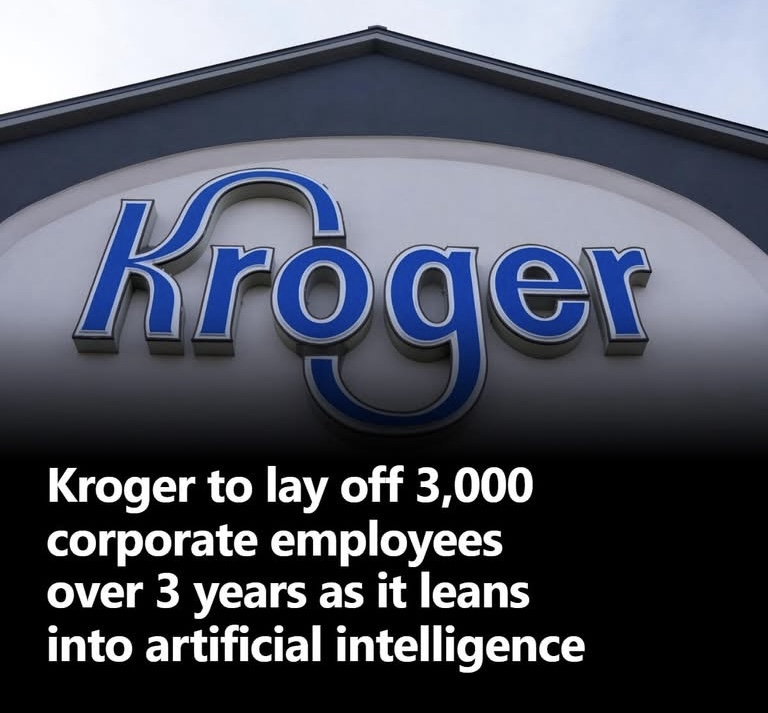
Kroger recently announced plans to eliminate approximately 3,000 corporate jobs over the next three years while expanding its use of artificial intelligence. That represents approximately 37% of its 8,200 corporate employees. This follows another approximately 1,000 corporate positions eliminated in 2025.
Kroger CEO Greg Foran describes the restructuring as an opportunity to streamline operations, eliminate redundant work, lower consumer prices, and redirect resources toward store employees. The company is also investing in AI technologies intended to automate workflows, improve operational efficiency, and enhance the customer experience.
These are corporate positions, not an announced elimination of store-level jobs. Nor has Kroger established that every eliminated position will be directly replaced by artificial intelligence. Those distinctions matter.
But there is a much larger issue here, one that corporate executives, shareholders, economists, technology companies, and political leaders need to confront before the consequences become much more difficult to reverse.
As humans who once had jobs increasingly fall into poverty, who exactly is going to purchase the products and services these corporations are producing?
Consider a typical high-volume King Soopers supermarket that might generate $1 million in daily sales. That represents approximately $365 million annually from a single store. That revenue does not magically appear. It comes from customers who have money to spend, overwhelmingly supported by income circulating throughout the economy.
Now imagine an economy in which corporations across every industry aggressively eliminate the jobs that previously provided those incomes.
Who is going to purchase the groceries? Who is going to buy the cars, homes, appliances, electronics, insurance, clothing, and countless other products and services that sustain our economy?
You cannot systematically eliminate the purchasing power of your customers and simultaneously expect them to continue supporting your business.
That is the fundamental economic contradiction behind the increasingly enthusiastic corporate pursuit of AI-driven workforce reductions.
One Company’s Labor Savings Become Another Company’s Lost Customers
A corporation that eliminates 3,000 jobs may improve its financial performance in the short term. Its executives may report reduced operating expenses, improved margins, increased productivity, and greater shareholder value. But what happens when thousands of other corporations independently make the same decision?
What happens when the employees eliminated by Kroger are also the customers of Walmart, Amazon, Ford, Apple, restaurants, healthcare providers, and thousands of small businesses? And what happens when those businesses eliminate their own employees, who were previously customers of Kroger?
One company’s labor savings become another company’s lost customers. Multiply that across the entire economy, and we create a potentially destructive cycle in which businesses collectively undermine the very consumer demand that sustains their existence.
Each corporation may believe it is making a financially responsible decision. Each CEO may present workforce reductions as a necessary competitive adjustment. Each board of directors may approve those decisions because they appear to improve profitability. But individual corporate decisions do not occur in economic isolation.
A company can reduce its labor expenses without immediately experiencing the economic consequences of the income it has eliminated. Those consequences are distributed throughout the broader economy. The problem emerges when enough companies pursue the same strategy simultaneously.
The economic gains remain concentrated among corporations, shareholders, and technology providers, while the losses spread across workers, families, communities, and the consumer economy.
Eventually, the reduction in consumer purchasing power can return to those same corporations in the form of declining sales, reduced demand, and shrinking opportunities for growth.
What appears profitable for an individual corporation can become economically destructive when replicated throughout the entire economy.
This is not merely a philosophical objection. It is a problem of systemic economic incentives and consequences.
In fact, economists have examined precisely this possibility. A March 2026 research paper titled “The AI Layoff Trap” models circumstances in which individually rational corporate automation decisions collectively produce excessive worker displacement and damage consumer demand, ultimately harming both workers and business owners.
That is the kind of economic analysis corporate boards should be studying before treating workforce elimination as an unquestionable measure of technological progress.
Capitalism Cannot Sustain Mass Consumption Without Purchasing Power
Modern consumer capitalism depends on people having sufficient income to purchase goods and services.
Businesses need customers. Customers need purchasing power. For most households, purchasing power depends substantially on employment and earned income. When employment income disappears, consumer demand does not automatically remain unchanged.
People reduce discretionary spending. They postpone purchases. They stop replacing vehicles and appliances. They reduce restaurant visits, entertainment, travel, and other expenses. Some struggle to afford housing, utilities, medical care, and even groceries.
Those reductions affect additional businesses, which may respond with further layoffs and cost-cutting. This creates the possibility of a self-reinforcing economic contraction.
Of course, technological innovation has historically created new industries, new occupations, and new opportunities. Productivity improvements can lower prices, increase output, raise wages, and improve living standards.
I am not arguing that every instance of automation inevitably causes unemployment or economic collapse. The critical question is whether the benefits of increased productivity are distributed broadly enough to sustain economic participation, and whether displaced workers can realistically transition into new opportunities quickly enough to maintain their livelihoods.
There is no guarantee that AI will create replacement jobs at the same pace, in the same communities, at comparable wages, or in sufficient numbers to absorb everyone displaced. And even if the economy eventually creates new opportunities, that does not eliminate the very real economic harm experienced by people whose jobs disappear in the meantime.
A worker who loses a career, healthcare coverage, retirement contributions, housing security, and financial independence cannot simply be told that technological progress may create some new industry ten years from now.
Corporate leaders need to recognize that their employees are not merely expenses appearing on a financial statement. They are also consumers, taxpayers, homeowners, parents, caregivers, community members, and participants in the broader economy.
Eliminating an employee does not eliminate the economic consequences of that employee losing an income. It simply transfers those consequences elsewhere.
And when enough corporations do this, those consequences can eventually return to the corporations themselves.
The Wealthy Cannot Remain Wealthy Without a Functioning Economy
There is another uncomfortable reality that the executives and shareholders celebrating widespread AI-driven workforce reductions should consider. If large portions of the population lose their ability to participate economically, the wealthy are not necessarily insulated from the consequences forever.
Corporate wealth depends on the value of businesses, investments, property, financial assets, and future earnings. Those valuations depend, directly or indirectly, on economic activity and expectations of future demand. If consumer purchasing power deteriorates substantially, businesses may experience declining revenue, shrinking markets, reduced profitability, and falling valuations.
The shareholders who initially benefited from eliminating labor expenses could eventually suffer from the collapse of the consumer markets that supported their investments. Even the wealthiest individuals depend on functioning economic institutions, supply chains, infrastructure, customers, and social stability.
They cannot indefinitely extract increasing financial returns from an economy whose participants are progressively losing the ability to purchase its output.
I find it remarkable that so much corporate attention is focused on the immediate financial benefits of replacing employees, while comparatively little attention is given to the cumulative economic consequences if everyone succeeds at doing the same thing.
If corporate greed continues concentrating wealth while systematically eliminating the incomes of ordinary consumers, the wealthy may eventually undermine the very economic system that created their wealth.
That does not mean every wealthy individual will become poor, or that economic collapse is inevitable. It means concentrated wealth does not make an economy immune to the consequences of widespread income displacement. At some point, there must be sufficient purchasing power somewhere in the system to support the businesses generating that wealth.
This should be a central concern of responsible corporate leadership.
AI May Not Remain Cheaper Than the Employees It Replaces
There is another assumption behind the corporate rush toward AI that deserves considerably more scrutiny.
Companies frequently justify AI adoption by comparing the cost of software against the cost of employing people. They calculate salaries, benefits, payroll taxes, training, office space, and other employment expenses. They compare those expenses against software subscriptions, API usage, infrastructure, and implementation costs.
They then project substantial savings. But those calculations often assume that the future cost of AI will remain sufficiently low to preserve those savings.
Why should corporate leaders assume that? Today, AI providers are competing aggressively for customers, market share, developer adoption, and enterprise integration. Many businesses are being encouraged to incorporate AI deeply into their operations, software platforms, business processes, and decision-making systems. Once those businesses become dependent on AI, the economic relationship can change.
A corporation that has eliminated much of its workforce and redesigned its operations around AI services may no longer have the practical ability to return to its previous operating model.
The institutional knowledge may be gone. Experienced employees may have moved on. Internal capabilities may have deteriorated. Critical workflows may now depend on proprietary models, cloud infrastructure, external APIs, and technology providers.
What happens when those providers increase their prices? What happens when the cost of inference, computing infrastructure, storage, data access, licensing, security, compliance, integration, and operational support rises?
What happens when a company discovers that its supposedly inexpensive AI workforce requires constant monitoring, validation, maintenance, incident response, and expensive engineering expertise?
And what happens when only a handful of enormously powerful technology companies control the infrastructure upon which thousands of other corporations have become dependent?
The corporations that believed they were eliminating labor costs may discover that they have exchanged those costs for a different form of dependency. One that may be considerably more difficult to negotiate, control, or escape.
AI will not necessarily become more expensive than human labor in every application. Some forms of automation will undoubtedly remain economically advantageous. But the assumption that AI will always be cheaper, or that today’s prices accurately represent its long-term operating costs, is not a sound foundation for irreversible workforce decisions.
Replacing employees with AI does not necessarily eliminate economic dependency. It can transfer that dependency from a company’s own workforce to a concentrated group of technology providers.
That is a strategic business risk, not merely an information technology consideration.
The Concentration of AI Ownership Could Become a Concentration of Economic Power
The companies controlling advanced AI models, computing infrastructure, specialized hardware, cloud platforms, and enterprise AI services may acquire extraordinary economic leverage.
As businesses become increasingly dependent on their technologies, those providers may gain the ability to influence pricing, availability, functionality, operating conditions, and even the practical capabilities of entire industries. The danger is not simply that AI companies may raise their prices.
It is that the ownership and control of increasingly essential economic capabilities could become concentrated among a relatively small number of extraordinarily wealthy corporations and investors.
Consider the implications of an economy in which millions of workers have been displaced, businesses have surrendered significant portions of their operational capabilities to external AI platforms, and the financial benefits of automation flow disproportionately toward the owners of those platforms. We could create an economy in which the technology required to participate competitively becomes increasingly controlled by those who already possess the greatest wealth.
That is not necessarily a more efficient or prosperous economy for everyone. It could become an economy characterized by extraordinary technological capability alongside increasingly concentrated wealth and diminished economic opportunity.
And if the displaced population no longer possesses sufficient purchasing power, the owners of those technologies may ultimately discover that controlling the means of production is not the same thing as having a healthy market for what is produced.
The ability to produce goods and services at unprecedented scale means very little if the population can no longer afford to consume them.
This is why AI leadership cannot be reduced to questions of technical performance, model capability, or immediate return on investment. It must include questions about economic distribution, market concentration, dependency, employment, and long-term sustainability.
AI Is Software, Not a Human Being
There is another issue I believe corporate leaders fundamentally misunderstand, and it concerns the nature of artificial intelligence itself.
I have spent decades working in software engineering, architecture, automation, and artificial intelligence. I understand the extraordinary capabilities of modern computing systems. I also understand the difference between a system producing an apparently intelligent result and a human being exercising intelligence, understanding, judgment, responsibility, and accountability.
Modern AI can perform remarkable tasks. It can recognize patterns, generate language, analyze information, write software, process images, assist with complex problems, and automate work that previously required substantial human effort.
But these capabilities do not make AI human.
AI is a software-based simulation or computational reproduction of certain aspects of human cognitive performance. It is not human intelligence in its full biological, experiential, social, and moral sense.
That distinction matters enormously. A system that produces convincing answers is not necessarily a system that understands the consequences of those answers in the way a responsible human decision-maker does.
A system that generates software is not necessarily capable of assuming responsibility for the security, maintainability, reliability, and real-world consequences of that software. A system that recommends a business decision is not a corporate executive who can be held accountable for the employees, customers, and communities affected by that decision.
And a system that appears to reason does not automatically possess the complete range of human judgment, lived experience, ethical understanding, or responsibility required to govern consequential activities.
The fact that AI can perform certain tasks more quickly or cheaply than people does not establish that it should be entrusted with every decision previously made by people. Nor does it establish that human expertise has become obsolete.
There has always been considerably more to software engineering than typing code. There has always been more to mathematics than performing calculations. There has always been more to playing a musical instrument than producing the correct notes. And there has always been more to medicine than generating a diagnosis.
Computers can calculate mathematical answers without eliminating the need for mathematicians. They can reproduce musical performances without eliminating the value of musicians. They can assist with medical diagnosis without eliminating the need for qualified medical professionals.
Likewise, AI can generate software without eliminating the need for competent software engineers who understand architecture, security, validation, reliability, systems integration, and the consequences of failure.
The value of human expertise is not confined to the mechanical execution of a task. It includes knowing what should be done, why it should be done, how to evaluate the outcome, when something is wrong, and who is responsible for correcting it.
AI should amplify human capabilities, not become an excuse to abandon the human expertise and judgment required to achieve successful outcomes.
AI Does Not Need to Hate Us to Destroy Us
One of the most dangerous misconceptions about artificial intelligence is the idea that AI must somehow become conscious, malicious, or hostile toward humanity before it can cause catastrophic harm. That is simply not true.
AI does not need to hate us to destroy us. It does not need human emotions. It does not need resentment, anger, jealousy, or a desire for power. It does not even need to understand that its actions are harmful in the way a human being would understand them.
A software system can produce destructive consequences simply by pursuing an objective that is incomplete, poorly specified, inadequately constrained, or fundamentally misaligned with human welfare.
An automated system instructed to maximize profitability may identify labor elimination as an effective means of reducing expenses. A system instructed to maximize efficiency may recommend removing human review processes because those processes consume time and resources.
A system instructed to reduce costs may recommend actions that appear economically beneficial within the boundaries of its optimization problem while imposing enormous costs on employees, customers, communities, or society. None of those outcomes requires malicious intent.
They require only an objective, sufficient capability, and inadequate constraints. This is a familiar problem in software engineering, although modern AI introduces new capabilities, complexity, and uncertainty. We have always needed to control what software is permitted to do.
We have always needed to validate its outputs, constrain its authority, protect sensitive information, and establish mechanisms for detecting and correcting failures. AI does not eliminate those requirements. It makes them more important.
And the more autonomy we delegate to AI systems, the more consequential failures of oversight and control can become.
The Real Danger Is Delegated Authority Without Adequate Human Oversight
Corporate leaders are increasingly enthusiastic about AI agents capable of independently executing tasks, interacting with software systems, accessing business information, and making or implementing decisions.
There are legitimate and valuable applications for these technologies. But capability should never be confused with authority. The fact that an AI system can perform an action does not establish that it should be permitted to perform that action without appropriate supervision.
A software agent may be capable of modifying production code, accessing customer records, changing business workflows, approving transactions, or initiating operational decisions. Those capabilities create risks that must be evaluated independently of the system’s apparent intelligence.
Who authorized the action? What permissions did the system possess? What information was it allowed to access? What constraints governed its behavior? How was its output validated? Who reviewed the consequences? What independent controls existed to prevent an unauthorized or harmful action? And who is accountable when something goes wrong?
These are fundamental questions of systems engineering, security architecture, corporate governance, and organizational responsibility. They cannot be answered simply by asserting that a model is intelligent, accurate, or highly capable.
Nor can they be answered by assuming that a collection of instructions or software guardrails will anticipate every possible failure. No finite set of instructions can guarantee that a sufficiently complex system will never encounter an unexpected condition.
That is why consequential software systems require layered controls, carefully scoped permissions, independent validation, monitoring, auditability, and mechanisms for human intervention.
Human oversight must also be meaningful. A human being who merely approves whatever an AI recommends without understanding or examining it is not providing effective oversight. The more consequential the decision, the stronger the justification required before allowing software to act autonomously.
The problem is not that AI might develop hatred toward humanity. The problem is that humans may give AI systems the authority to pursue objectives without adequately controlling the consequences.
And those objectives may themselves be chosen by executives whose priorities are dominated by cost reduction, market power, and shareholder returns.
Corporate Executives, Not AI, Are Making These Decisions
This brings us back to Kroger.
Artificial intelligence did not independently decide to eliminate 3,000 corporate positions. Human executives made that decision. Kroger’s leadership has described the restructuring as an effort to simplify operations, reduce overhead, improve competitiveness, and invest in other parts of the business. Those are management decisions.
The company’s AI investments may support aspects of that strategy, but the available reporting does not establish that AI directly replaces every eliminated position. Nevertheless, the broader relationship between workforce reduction and technological adoption raises legitimate questions about the priorities guiding corporate leadership.
If AI makes a company substantially more productive, why should the primary financial benefits necessarily flow to shareholders? Why should increased productivity automatically be treated as justification for eliminating employees?
Why not use those productivity gains to improve working conditions, reduce employee workloads, increase compensation, strengthen customer service, lower consumer prices, expand the business, or develop new products and services?
Why not allow employees to become more effective through AI rather than assuming that greater efficiency requires fewer employees? These are choices. They are not inevitable consequences of technological progress. A company can adopt AI to strengthen its workforce. It can also adopt AI to reduce its workforce. Those are fundamentally different leadership strategies, even when they use similar technologies.
And while reducing unnecessary duplication or reorganizing an inefficient business can sometimes be justified, responsible leadership should evaluate the human, operational, economic, and strategic consequences rather than treating headcount reduction as an automatic success.
The fact that technology makes a particular decision possible does not establish that the decision is wise.
Corporate executives cannot outsource responsibility for their decisions to the technology they choose to deploy.
AI is not the CEO. AI is not the board of directors. AI is not the shareholder demanding higher returns. AI is not the person deciding which employees will lose their livelihoods. Human beings occupy those positions and make those decisions. They should be held responsible for the consequences.
The Short-Term Profitability Trap
One of the greatest weaknesses in modern corporate leadership is the tendency to confuse short-term financial optimization with long-term business success.
Reducing payroll can improve financial metrics. Eliminating departments can reduce operating expenses. Automating processes can increase measured productivity. But those metrics do not, by themselves, establish that an organization has become stronger.
A company can improve its quarterly financial results while weakening its institutional knowledge, engineering capabilities, customer relationships, operational resilience, and ability to innovate.
It can reduce labor expenses while increasing its dependence on outside technology providers. It can eliminate experienced employees whose knowledge would be extraordinarily expensive or impossible to reconstruct. It can report improved productivity while transferring hidden costs to customers, remaining employees, contractors, and the broader economy.
And it can increase shareholder returns in the short term while damaging the consumer purchasing power required to sustain those returns over time. This is why corporate leaders must distinguish between cost reduction and genuine value creation.
A business that becomes more efficient by helping employees produce better outcomes is not necessarily equivalent to a business that becomes more efficient by eliminating those employees. The financial statements may initially look similar. The long-term organizational and economic consequences may be profoundly different.
The responsibility of leadership is to understand those differences before making decisions that cannot easily be reversed.
What Responsible AI Leadership Should Actually Look Like
I am not opposed to artificial intelligence. Quite the opposite.
I have spent decades developing software and working with technologies that improve what computers and people can accomplish together. I understand the extraordinary value of automation, machine learning, intelligent systems, and modern AI.
I am strongly opposed to the irresponsible use of those technologies. I do not condone treating AI as a convenient justification for replacing human beings simply because a spreadsheet suggests that doing so will improve short-term profitability.
I believe AI should be used to improve human productivity, expand human capabilities, reduce unnecessary burdens, solve difficult problems, and create opportunities that would otherwise be unavailable.
That does not mean every existing job or business process must remain unchanged forever. It means workforce displacement should not be treated as the primary objective or celebrated as the defining achievement of technological innovation.
Responsible corporate leaders should be asking how AI can make their organizations more capable, their employees more valuable, their customers better served, and their businesses more sustainable.
They should evaluate the total cost of ownership, including technology subscriptions, infrastructure, security, validation, engineering support, operational dependencies, and vendor pricing power.
They should understand the consequences of losing institutional knowledge and specialized human expertise.
They should consider whether AI-generated outputs are reliable, whether the systems are secure, and whether sufficient human oversight exists for consequential decisions. They should examine how productivity gains are distributed among employees, customers, shareholders, and technology providers.
They should assess the broader economic consequences of widespread workforce displacement rather than assuming that the economy will automatically absorb every displaced worker without substantial harm.
And they should recognize that a company’s employees are not merely a cost center.
They are part of the economic system that sustains the company’s customers, suppliers, communities, and future growth. There is nothing inherently wrong with improving productivity or profitability.
The question is whether those improvements are achieved in ways that strengthen the organization and the economy, or in ways that progressively undermine both.
The measure of successful AI leadership should not be how many human beings a corporation can eliminate. It should be how much more value the corporation can create while preserving human accountability, economic participation, and long-term sustainability.
The Question Corporate Boards Need to Answer
Kroger’s announcement is one example of a much larger challenge confronting corporate America.
It is entirely possible for a company to improve efficiency, reduce unnecessary expenses, and invest in new technologies without creating a broader economic crisis. It is also possible for AI to generate substantial new wealth, create valuable new industries, lower prices, and improve living standards.
But those outcomes are not guaranteed merely because the technology is powerful. They depend on the decisions made by the people and institutions controlling its development and deployment.
If AI productivity gains become concentrated among a relatively small number of corporations and wealthy investors while millions of workers lose their incomes, the economic consequences could be severe. If corporations become dependent on increasingly concentrated AI providers, the cost savings they celebrate today may be eroded by escalating technology expenses and diminished bargaining power tomorrow.
If businesses eliminate the human expertise required to understand and control their own systems, they may discover that automation has created new operational risks rather than eliminating old ones.
And if corporate executives delegate increasingly consequential decisions to AI systems without meaningful human oversight, they may expose employees, customers, shareholders, and society to failures that no software model can be held morally or legally responsible for in the same way as its human operators.
These are not reasons to abandon AI. They are reasons to demand considerably better leadership. The central question is not whether AI can replace human labor. The question is whether replacing that labor actually produces sustainable economic and human benefits.
And the most important question may be this:
What happens when every corporation succeeds in eliminating the employees who once earned the money to purchase its products?
One company’s labor savings become another company’s lost customers. One company’s improved margins become another company’s declining revenue. One company’s automated workforce becomes another company’s shrinking consumer market.
Multiply those decisions across the economy, and the relentless pursuit of short-term profitability can undermine the very economic system that makes those profits possible.
The executives and shareholders celebrating the elimination of human labor should consider whether they are gradually destroying their own future customers.
Because even the most sophisticated AI cannot generate sustainable consumer purchasing power simply by producing more goods and services that increasingly impoverished people cannot afford.
AI Is Not the Enemy. Irresponsible Human Leadership Is.
I want to leave corporate leaders, shareholders, technology executives, and policymakers with one final thought.
Artificial intelligence does not need to become conscious to harm humanity. It does not need to develop hatred toward human beings. It does not need malicious intentions. It does not even need to possess human intelligence.
It only needs to be placed in the hands of people who prioritize the wrong objectives, grant it excessive authority, fail to establish effective controls, and disregard the consequences of their decisions.
The greatest danger may not be an artificial intelligence that decides humanity is unnecessary. It may be corporate leaders who decide that human beings are unnecessary because artificial intelligence appears to offer a cheaper alternative.
And in pursuing that objective, they may progressively destroy the employment, purchasing power, economic participation, and social stability upon which their own businesses depend. The result would not be an AI rebellion. It would be a failure of human leadership.
AI does not need to hate us to destroy us. Those who exploit it, who prioritize greed over human welfare, and who allow it to pursue consequential objectives without intense and meaningful human oversight may become the true destroyers of humanity’s economic security and prosperity.
Not because AI independently chose that outcome. But because the people controlling it did. And when the consequences finally reach the corporations, executives, and shareholders who believed themselves insulated from the harm, it may become painfully obvious that eliminating the people who sustain an economy was never a sustainable business strategy.
AI should be an amplifier of human intelligence, productivity, and prosperity, not a mechanism for concentrating wealth while eliminating the human beings who make that prosperity possible.
That is the leadership challenge of artificial intelligence. And it is one we cannot afford to ignore.
Richard Armstrong Software Engineer, Software Architect, and AI Developer High Vision Systems LLC