AI-generated code must be treated as untrusted code and subjected to the same rigorous review, testing, and validation as code from any other source. Software development is not primarily the act of typing syntax, just as engineering is not primarily the act of drawing blueprints.
Generating code is only a tiny part of software engineering. The far more difficult work is determining requirements, designing architecture, choosing appropriate abstractions, understanding tradeoffs, managing state and concurrency, securing systems, integrating components, handling failure modes and edge cases, debugging unexpected behavior, validating correctness, maintaining systems over years, and recognizing when an apparently reasonable solution is dangerously wrong.
AI can produce thousands of lines of plausible code faster than an experienced engineer can type them, but if nobody involved has the expertise or time to determine whether those lines are correct, secure, maintainable, and actually satisfy the requirements, you have accelerated code production without establishing software quality.
AI Can Generate Code Faster Than Humans Can Validate It
Successful use of AI in software development requires that qualified software engineers are not overwhelmed by the volume of generated code they must understand, test, challenge, and maintain. Saturating those engineers simply results in code being forced through the pipeline without adequate scrutiny.
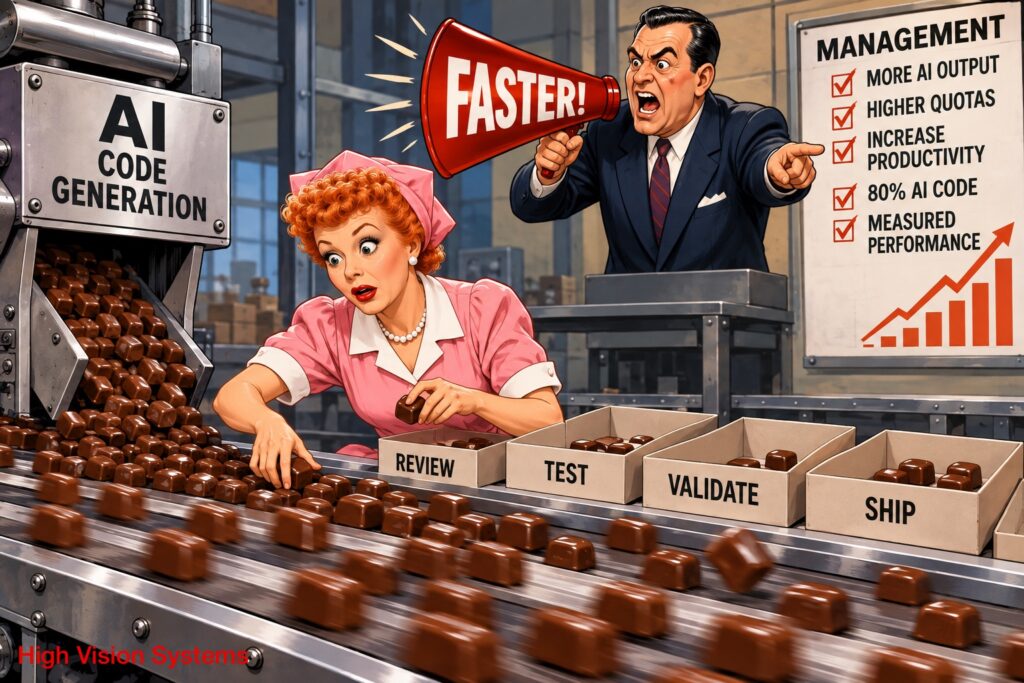
It reminds me of the classic “I Love Lucy” chocolate-factory scene. The conveyor belt keeps moving faster and faster until Lucy and Ethel cannot possibly inspect and package everything coming at them. They start stuffing chocolates into their mouths and clothes just to keep them from hitting the floor.
Now imagine management standing behind them demanding that the conveyor belt run even faster because “productivity” is measured by how many chocolates come down the belt.
Some corporate leaders are establishing aggressive AI-adoption and code-generation targets and tying AI usage to developer expectations and performance.
Generated-Code Volume Is Not Software Quality
Generated-code volume is not software quality. If AI produces code faster than qualified engineers can validate it, increasing AI-generated-code percentages increase the verification burden while creating the appearance of increased productivity.
The consequences of poorly supervised AI coding are not theoretical. AI coding agents have already demonstrated destructive behaviors when given excessive autonomy or permissions, including modifying or deleting code and data, taking unintended actions, bypassing intended workflows, and making confident decisions based on incorrect assumptions.
The more authority we give these systems, the more important engineering oversight becomes, not less.
AI Should Amplify Software Engineers, Not Replace Them
The problem is leadership treating AI-generated code as a substitute for software engineering.
AI should amplify qualified software engineers, not replace their judgment.
Companies are not eliminating the cost of software engineering. They are postponing it.